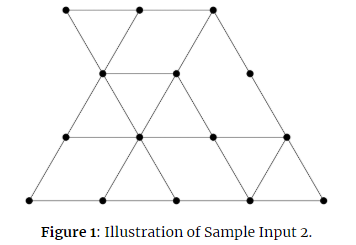
The first line of input contains two integers $r$ and $c(1≤r≤3000,1≤c≤6000)$, specifying the picture size, where $r$ is the number of rows of vertices andcis the number of columns. Following this are $2r−1$ lines, each of them having at most $2c−1$ characters. Odd lines contain grid vertices (represented as lowercasexcharacters) and zero or more horizontal edges, while even lines contain zero or more diagonal edges. Specifically, picture lines with numbers $4k+1$ have vertices in positions $1,5,9,13,…$ while lines with numbers $4k+3$ have vertices in positions $3,7,11,15,...$. All possible vertices are represented in the input (for example, see how Figure 1 is represented in Sample Input 2). Horizontal edges connecting neighboring vertices are represented by three dashes. Diagonal edges are represented by a single forward slash (‘/’) or backslash (‘\’) character. The edge characters will be placed exactly between the corresponding vertices. All other characters will be space characters. Note that if any input line could contain trailing whitespace, that whitespace may be omitted.
 Comet OJ