
C0515 [CEOI2008Day2] Choosing Orders and Renting Machines

内存限制:256 MB 时间限制:1000 ms

题目描述

Carpenter Sam receives $N$ orders. While reading the orders she realizes that she is missing $M$ machines necessary to complete the orders. Not all orders require all missing machines, but every order requires at least one of them.

To complete an order, Sam needs to either buy or rent each of the machines the order requires. Since different orders need different amounts of work (and thus time) on each machine, the rent for a machine may depend on the order that is completed on it. The purchase cost for a machine do not depend on the orders, though. A machine which is purchased once can be used to work on any number of orders at no extra cost.

If the cost caused by an order seem too high to Sam, she may choose to reject an order; this will lead to no cost (and no profit). Help Sam decide which orders to reject, which machines to buy, and which machines to rent in order to maximize her profit.

Example

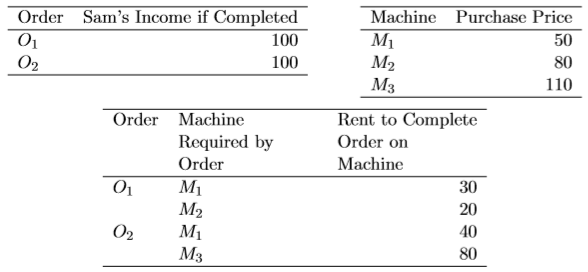
$N = 2, M = 3$

image.png

There are two solutions leading to the maximum profit of 50:

  • Reject $O_2$, complete $O_1$, rent both $M_1$ and $M_2$.
  • Complete both $O_1$ and $O_2$, buy $M_1$, rent $M_2$ and $M_3$.

输入格式

The first line of the input contains two integers, $N (1≤ N ≤1200)$ and $M (1≤ M ≤1200)$.

The following $N$ blocks of lines each describe an order; they are structured as follows: The first line of block $i$ contains two integers, the income value $v_i (1 ≤ v_i ≤ 5000)$ for order $O_i$ and the number of machines $m_i (1 ≤ m_i ≤ M)$ needed for $O_i$. The following $m_i$ lines each specify a machine $j (1 ≤ j ≤ M)$ needed to complete $O_i$ and the rent $r_{ij} (1 ≤ r_{ij} ≤ 20000)$ needed to rent this machine for this order.

The $M$ lines after the last order block contain one integer each: the purchase price $s_i (1≤ s_i ≤ 20000)$ for each machine.

输出

The output contains exactly one integer: the maximum achievable profit.

样例

样例输入 1

2 3 100 2 1 30 2 20 100 2 1 40 3 80 50 80 110

样例输出 1

50

提示